Showing posts with label New Zealand. Show all posts

Monday, 9 September 2013

Waitomo Glowworm Caves - New Zealand

The Waitomo Glowworm Caves, located just outside the main Waitomo township on the North Island of New Zealand, is a famous attraction because of a sizeable population of glowworms that live in the caves. Glowworms or Arachnocampa luminosa are tiny, bioluminescent creatures that produce a blue-green light and are found exclusively in New Zealand.
The Waitomo Glowworm Caves were first explored in 1887 by local Maori Chief Tane Tinorau accompanied by an English surveyor Fred Mace. Local Maori people knew of the Caves existence, but the subterranean caverns had never been extensively explored until Fred and Tane went to investigate. They built a raft of flax stems and with candles in hand, floated into the cave where the stream goes underground.

Thursday, 9 May 2013

Beautiful Blue Lake - New Zealand

Blue Lake is a small lake at the foot of the Tasman Glacier in inland Canterbury, in the central South Island of New Zealand. Its outflow is the Tasman River, part of the Waitaki River system.

Sunday, 28 April 2013

Colorful flowering lupines at Lake Tekapo

Lake Tekapo - the second largest of the three, roughly parallel lakes located between the north and south along the northern edge of the Mackenzie Basin in the South Island of New Zealand. Lake - a real photographer's dream, with the mountains and snow capped peaks, turquoise blue lake and charmingly beautiful little church. Every year from mid-November to December, the beauty enhanced by colorful flowering lupine. Russell lupine (Lupinus polyphyllus) is an exotic plant that can grow up to 1.5 meters in height. It is a constant variety, the seeds are planted in the summer, die back for the winter to be resurfaced next summ.  Flowers are like peas and have a variety of colorings - blue, purple, orange, yellow, pink, white or a mixture of the two colors. Leaves are divided into processes, reminiscent of the fingers. Strong baskets with seeds ripen and explode in the summer heat, releasing a lot of dark brown seeds. Russell lupins were planted in 1950 at the height of Connie Scott Godley, when the seed was scattered along the sides of the main highway. These high spikes now grow in bundance along many roadsides and open areas around the villages, and throughout the scenic area Mackenzie. The variety of colors makes a stunning area of ​​Lake Tekapo photographers paradise.

Tuesday, 24 January 2012

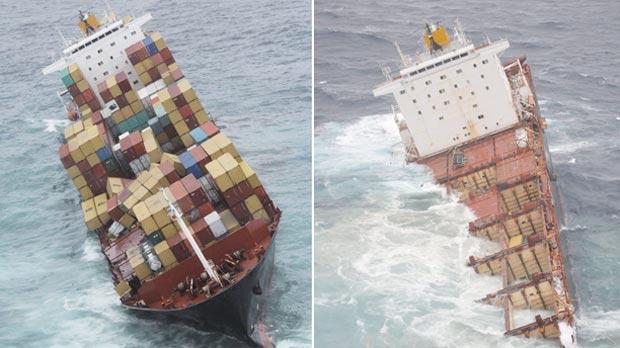
New Zealand cargo ship disaster

New Zealand cargo ship disaster


One half of a cargo ship that ran aground on a New Zealand reef three months ago began sinking into the ocean Jan. 10. The stranded cargo ship Rena broke in two pieces on Jan. 8 after storms with 19-foot waves pounded the vessel. The Greek-owned Rena ran aground 14 miles from Tauranga Harbor on North Island on Oct. 5, 2011, spewing heavy fuel oil into the seas in what has been described as New Zealand's worst maritime environmental disaster.


Thursday, 29 December 2011

New Zealand - World's Youngest Country

New Zealand - World's Youngest Country

New Zealand is an island country in the south-western Pacific Ocean comprising two main landmasses (commonly called the North Island and the South Island), and numerous smaller islands. It is notable for its geographic isolation 


Wednesday, 21 December 2011

New Zealand Oil Spill - Country's Worst Environmental Disaster

New Zealand Oil Spill - Country's Worst Environmental Disaster


The Rena is a container ship owned by the Greek shipping company Costamare Inc. The oil spill occurred off the coast of Tauranga in New Zealand due to grounding of MV Rena on the Astrolabe Reef. The spill has been described as New Zealand's worst maritime environmental disaster. 
The ship was carrying 1,368 containers, eight of which contained hazardous materials, as well as 1,700 tonnes of heavy fuel oil and 200 tonnes of marine diesel oil. Initially the ship listed 11 degrees to port, with the front stuck on the reef. By Sunday, 9 October 2011, a 5 kilometres (3.1 mi) oil slick threatened wildlife and the area's rich fishing waters.


Related Posts Plugin for WordPress, Blogger...