Showing posts with label Europe. Show all posts

Thursday, 26 June 2014

10 most cozy Italian towns

To start the holiday period many of our compatriots are chosen as a place to stay beautiful Italy. For those who can not be surprised bustle of the eternal city of Rome and Milan shopping our selection of the most cozy Italian cities on the coast. Probably each of us ever dreamed to spend if not life, then at least a vacation in a quiet hamlet on the beach, drinking coffee and wine tasting at local restaurants, listening to the voices of gulls and surf.
Choose! 


1. Vernazza
Vernazza is the most organic, beautiful and picturesque town Italian "pyatizemelya" (Cinque Terre) Liguria. Today it is home to just over a thousand people, so Vernazza is also one of the quietest towns and compete with them can only calm Manarola. On a background of multicolored multi-storey houses-towers are evident older medieval walls of galleries, palaces, monasteries and, of course, the castle, whose low walls once protected the rest locals from pirate raids. In the narrow streets of Vernazza, at steep angles going down to the sea, at almost every step, you can see the boats, "parked" at home so naturally as look cars standing in our backyards at entrances.

Monday, 23 June 2014

Historical Tower of Hercules

In 61 BCE a Roman seaborne expedition, probably led by Julius Caesar himself, landed at present-day La Coruña (Brigantium) with the intention of installing a port and commercial settlement. There had already been Roman colonisation along the Mediterranean facade of the Iberian Peninsula and along the south and south-west from the 2nd century BCE. The port of Brigantium played an important role during the Cantabrian Wars (29-19 BCE). Once peace was restored, its strategic maritime role at the entrance to the Bay of Biscay, as well as that of a trading station, were confirmed. It became a rear base for the conquest of the British Isles while Galicia was being Romanised.
Under the name of Farum Brigantium, the Tower was probably erected in the 1st century CE, at the latest in the reign of Trajan (98-117). The votive inscription on a small ancillary construction would appear to bear this out. This monumental lighthouse is located at the entrance to La Coruña harbour, in the north-west of the Iberian Peninsula. It is designed to facilitate navigation along the rugged Galicia coastline, on a strategic point on the sea route linking the Mediterranean to northwest Europe.

Sunday, 27 October 2013

Circling Trains In Brusio - Switzerland

The Brusio spiral viaduct is a single track nine-arched stone spiral railway viaduct located in Brusio, in the Canton of Graubünden, Switzerland. Like most spiral tracks, the Brusio spiral viaduct was built to allow trains to gain elevation in a relatively short distance. The spiral viaduct is 110 meters long, has a horizontal radius of curvature of 70 meters, a longitudinal slope of 7%, and is made up of nine spans, each 10 meters in length. The viaduct lifts the train by 20 meters. The Brusio spiral viaduct forms part of the Bernina Railway section between Brusio and Campascio, and is approximately 55 kilometres from St. Moritz. The stone-built viaduct was opened on 1 July 1908, upon the opening of the Tirano–Poschiavo section of the Bernina Railway. In 1943, the whole of that railway company was taken over by the Rhaetian Railway, which still owns and uses the spiral viaduct today.

Friday, 19 July 2013

Bishop Rock World's Smallest Island

Bishop Rock is a small rocky ledge jutting out of the sea, 4 miles west of the Isles of Scilly in Cornwall. The rock rises from a depth of 45 meter to expose a tip 46 meters long by 16 meters wide. On this narrow ledge stands a lighthouse, which makes Bishop Rock the world's smallest island with a building on it, as recognized by the Guinness Book of Records. The rocks around the Scilly Isles caused the wreck of many ships over the years. When Sir Cloudesley Shovel's squadron of the British Fleet sank in 1707 along with 2,000 men, the Elder Brethren of Trinity House decided that the lighting of the Scilly Isles, which at that time consisted of only the old lighthouse at St. Agnes, was inadequate, and resolved to build a lighthouse on the most westerly danger, the Bishop Rock.

Thursday, 4 July 2013

Stanserhorn Cabrio - Amezing Two Storey Cabin Cableway

 Ruslan Eunice wrote: "The cable car Stanserhorn Cabrio has its origins in the Swiss town of Stans (Stans), a few kilometers from Lucerne, Canton of Nidwalden (Nidwalden). And it leads to Mount Stanserhorn (Stanserhorn) altitude 1898 meters above sea level. Opened as recently as May 2012. Is unique in that passengers have the opportunity to ride on the world's first two-story-Convertible telekabine. The upper floor has a roof, and tourists can feel the wind blow, breathe fresh air and enjoy the gorgeous 360-degree view. "

Sunday, 30 June 2013

Ronda - Town on The Rocks (Spain)

Ronda - a small but very picturesque Spanish town located in the northwest of the province of Malaga. On the official website of the city it is called the soul of Andalusia - and for good reason, because it's unique charm does not leave anyone indifferent tourists who visited the place. Colorful Spain has lost a lot would not if she had such an interesting angle, so visit Ronda - one of the essential tasks for any self-respecting traveler.

The main feature of the city is its location - it is a hill, divided into two deep gorge at the bottom of which flows the river Guadalevin (Guadalevín).

Saturday, 15 June 2013

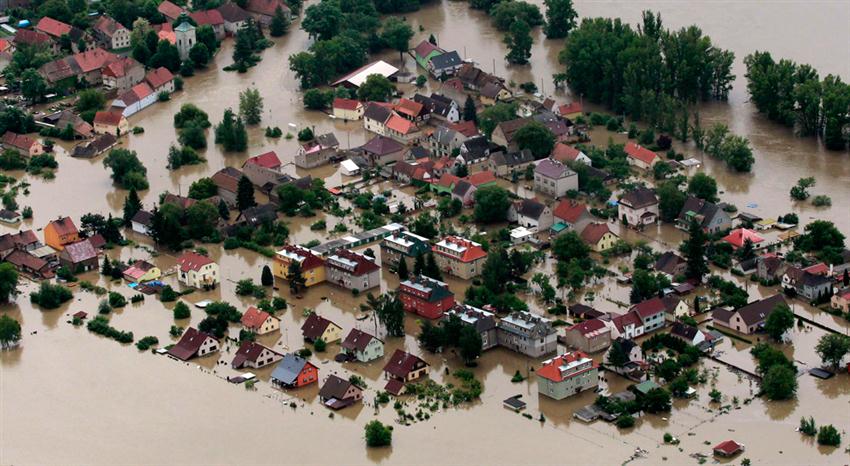
Flooding in Europe, The Danube River Reached its Highest Level in 500 Years

The Danube River reached its highest level in 500 years. The Elbe, Rhine, and other rivers and tributaries are cresting high as well as swathes of central Europe lie inundated by floodwaters that have killed 12 and displaced tens of thousands. Germany, Austria, Switzerland, and the Czech Republic have been severely affected, as Hungary prepares for the swell of water. Gathered here are images of the flooding and people affected in the last several days. -- Lane Turner

Tuesday, 14 May 2013

The Landscape Laboratory in Portugal

Completed last year, the Landscape Laboratory in Portugal is a modern restoration of an old stone factory. The renovation was designed by Porto-based Cannata & Fernandes Architects, who sought to preserve the existing structures as much as possible. Many features - including the original stone walls - have been left untouched, while the interior was adapted to new times and uses. Located southwest of the historic city center of Guimarães, Portugal, the Landscape Laboratory stands in a rural area near the National Ecological Reserve (REN). The architects preserved the original factory typology, which consists of a series of modules surrounded by green spaces, water channels and trails. The stone façade was recovered, cleaned and fixed with bricks, while new concrete volumes were added to adapt the building for modern use. Its interiors are contemporary, bright, open and filled with natural light. Some areas (like a small kitchen) mimic the building’s exterior factory typology. Set next to the Ribeira de Selho canal, the Landscape Laboratory is a beautiful renovation that blends history and modernity under one roof

Monday, 6 May 2013

Tropical island under the dome

Sandy beaches, clear blue water, palm trees ... I think we're talking about a tropical island? Well, in a sense, this is an island, but it is located under the dome in the indoor leisure and entertainment complex, which is located on a former Soviet air base in Krausnike, Germany.

Saturday, 27 April 2013

Adolf Hitler's life in pictures

"By the 124th anniversary of Adolf Hitler": Adolf Hitler ... About him thousands of pages, historians and political scientists, philosophers, and writers are turning to his identity, trying to understand the phenomenon of Hitler. We try to look at the life of this controversial personality through the lens of a small collection of rare archival photographs, arranged in chronological order.

Thursday, 25 April 2013

Metropol Parasol The World's Largest Wooden Structure

Metropol Parasol is a wooden structure located at La Encarnación square, in the old quarter of Seville, Spain. Designed by German architect Jürgen Mayer-Hermann, the structure resembles a grove of prefabricated wooden trees soaring 26 meters into the air. It has dimensions of 150 by 70 metres and claims to be the largest wooden structure in the world. The building is popularly known as Las Setas de la Encarnación (Incarnación's mushrooms).
The Metropol Parasol actually is a device for revitalising the Plaza de la Encarnación, which was used as a parking lot for years and seen as a dead spot between more popular tourist destinations in the city. The structure consists of six parasols in the form of giant mushrooms, whose design is inspired by the vaults of the Cathedral of Seville and the ficus trees in nearby Plaza de Cristo de Burgos. The Parasol contains a market, shops, and a podium for concerts and events. In the basement is an Antiquarium, where Roman and Moorish remains discovered on-site are displayed in a museum. On the roof there is an open-air public plaza, shaded by the wooden parasols above and designed for public events. There are panoramic terraces, including a restaurant, offering one of the best views of the city centre.


Friday, 19 April 2013

Footbridge “Slinky Springs To Fame”

This unusual pedestrian bridge is located in Oberhausen, Germany. The bridge consists of 496 steel ring and goes to the river Rhine. Locals especially like to walk on bridge at night, because the lighting is beautiful.


Monday, 15 April 2013

Decommissioned Sea Fort Reborn as Luxury Island Retreat

After being sold by the Ministry of Defense in 1982, the decommissioned Spitbank Fort went through a number of private owners before finally being purchased by Clarenco Group and its executive chairman, Buckinghamshire entrepreneur Mike ClareLed by Clare, the group spent $4.5 million to refurbish the former military stronghold and transform it into a luxury island resort that is fast emerging as one of the top getaway destinations in the U.K. 

Sunday, 14 April 2013

Most Popular Ski Resorts in Turkey


Uludag is located 36 kilometers (22 miles) from Bursa and is one of the most popular ski resorts in Turkey. Although as winter travel destination under development, Uludag attracts the attention of people since ancient times, with its numerous examples of early Ottoman architecture and archaeological sites to be found in these parts. Uludag in ancient times it was, where according to legend, the gods watched the Trojan war.
The highest mountain in northwestern Turkey Kara Tepe, high 2543 meters (2781 yards), you can see all the way from Istanbul, 276 kilometers (171 miles) away. Uludag attracts tourists all year round thanks to its green forests, valuable historical monuments, thermal baths and modern accommodation. Ski season lasts five months, from December to April, and there are 13 ski runs of varying severity that are associated with 24 different lifts. The most popular activities for tourists are definitely skiing and hiking, and relaxing in the numerous spa centers. For those who after all-day of winter sports, want to party, minibuses from Bursa to the top of the mountain you can catch an every hour. This very beautiful and attractive ski-center contains numerous bars, restaurants and shops.


Unusual Night in Nature

Two French hotel/camp,  Attrape Reves in Bouches-du-Rhone (near Marseille) and Sky River near Loir-et-Cher,  are the places where you can sleep under the stars. Concept of sleeping in balloons are designed by French designer Pierre Stefan, wanting to create an environmentally friendly space: when a plastic bubble pack, the area remains almost intact. Balloons are small and cozy, their diameter is about four meters. Some are completely transparent, while others provide a little more privacy.
Of course, if you want comfort that provides, for example, “Ric”, these unusual balloons are probably not for you. But if you want to fully protected sleep surrounded by nature and watch the stars from bed – go to this travel destination. Maybe you wake up when squirrel staring at your face ? Let’s just hope no bears around.
Sleeping under the stars gets a new meaning in the unusual “camps” in France – visitors are accommodated in nature under the open sky. Of course, there are more luxurious variants, and those with deeper pockets can choose balloons that are placed above the Whirlpool tub.


The Best Honeymoon Destination Bora Bora Island

Bora Bora is an island in the Leeward group of the Society Islands of French Polynesia, an overseas collectivity of France in the Pacific Ocean. The island, located about 230 km (140 mi) northwest of Papeete, is surrounded by a lagoon and a barrier reef. In the centre of the island are the remnants of an extinct volcano rising to two peaks, Mount Pahia and Mount Otemanu, the highest point at 727 m (2,385 ft).
Bora Bora is a major international tourist destination, famous for its aqua-centric luxury resorts. The major settlement, Vaitape, is on the western side of the main island, opposite the main channel into the lagoon. Produce of the island is mostly limited to what can be obtained from the sea and the plentiful coconut trees, which were historically of economic importance for copra. According to a census performed in 2008, the permanent population of Bora Bora is 8,880.

Saturday, 13 April 2013

The Sunken Bridge of Fort de Roovere

During the 17th century, a series of moats and fortresses were built over the West Brabant Water Line region of the Netherlands to provide protection from invasion by France and Spain. Fort de Roovere was surrounded by a shallow, muddy moat that was too deep to march across and too shallow for boats. Recently the fort was opened for tourist but instead of building an overbridged over the moat which would have definitely taken away the fort’s dramatic view, a sunken bridge was designed. 
From afar, the bridge is invisible to the eye. The flow of the moat appears continuous, as the water level remains at the same level. As visitors approach the fort, the bridge appears as a break in the water. The project was recently awarded with the prestigious BNA (Union of Dutch Architects) Building of the Year 2011, Southern Region.


Sunken Observation Platform in the Middle of a Pond

There is a clever observation platform built into a pond in  Vöcklabruck, Austria. The platform, rather than being raised, is sunken into the water allowing visitors to walk below the water's surface without getting wet. Pictures of this pond, first reported by Bored Panda, and quickly picked up by other publications, are currently circling the Internet but no additional information seems to have been collected. Some readers speculate what would happen during floods, but if you notice carefully, water is already spilling over the walls into the deck. So there is likely a drainage system in place that keeps the deck water free even during floods or heavy rainfall.

Friday, 12 April 2013

Gruner See, Styria A Park That Turns Into a Lake in Summer

Grüner See, literally “Green Lake”, is a lake in Styria, Austria, near the town of Tragoss, located at the foot of the snow-capped Hochschwab mountains. During winter, the lake is only 1–2 meter deep and the surrounding area is used as a county park. It is a particular favourite site for hikers. But as the temperature starts rising in spring, the ice and snow on the mountaintops begins to melt and runs down into the basin of land below. The lake swells up to engulf the entire area including the park. During summer, the lake reaches its maximum depth of around 12 meter and is claimed to look the most beautiful at this time.
The lake gets its distinctive green colouring, and the name, from the grass and foliage beneath, and thanks to the fresh snow melt, the ice-cold water is crystal clear clear. The temperature of the lake is rather cold at 4 to 8 °C, yet it’s popular among divers who can observe the green meadows in the edge zone of the lake particularly in June when the water is at its highest. The alpine grasses and flowers of the meadow are visible in full bloom under the water. One can even see benches, a bridge and walking trails. Starting July, the lake starts to recede and by winter, the lake is back to its original size and the park is returned once more to the hikers.


Related Posts Plugin for WordPress, Blogger...